

That musty, earthy smell you just can't seem to get rid of is more than an annoyance. It’s often the very first sign of a hidden mold problem brewing in your carpet. Before you can even think about cleaning it, you have to know what you’re looking for. Catching it early is absolutely crucial to stop a small spot from turning into a major issue that tanks your home's air quality, a cornerstone of the services provided by Simon Air Quality.
Identifying a Mold Problem in Your Carpet

Spotting mold isn’t always as easy as finding a big, obvious dark splotch. It often starts small, so you need a sharp eye and have to trust your senses. The easiest thing to spot is a visual change, but don't just look for the infamous black mold. It can show up as patches of green, white, or even orange discolouration on the carpet fibres. Look closely for fuzzy, circular, or thread-like patterns growing on the surface.
Beyond just the colour, pay attention to how the carpet feels. An area that used to be soft might now feel damp, a bit slimy, or strangely hard and crusty. This texture change is a clear sign that moisture has been lingering long enough for a mold colony to establish itself. At this stage, it's highly likely the problem has seeped into the carpet padding and even the subfloor below.
Beyond What You Can See
Sometimes, the first clues have nothing to do with sight or touch. Your own body might be the first to sound the alarm. If you or your family suddenly start dealing with more allergy-like symptoms—sneezing, coughing, itchy eyes, or a scratchy throat—it could be a reaction to airborne mold spores. It’s a major red flag if these symptoms get worse when you're in one particular room, indicating a localized air quality issue.
An ongoing musty odour is one of the most reliable indicators of a mold issue. That smell, often described as earthy or like damp soil, comes from Microbial Volatile Organic Compounds (MVOCs)—gases that mold releases as it grows. Trust your nose; if it smells like mold, it probably is.
To be certain, it's important to know how to test for mold to confirm what you're dealing with and understand how big the problem really is. What you see on the surface can just be the tip of the iceberg, and a professional assessment from Simon Air Quality can provide the definitive answers you need.
It's also worth getting familiar with strategies for identifying hidden mold sources, because the real problem might not even be the carpet itself. Here in Canada, our humid summers and damp winters can create the perfect storm for mold growth, making moisture control a top priority for homeowners.
Essential Safety Measures for Mold Cleanup
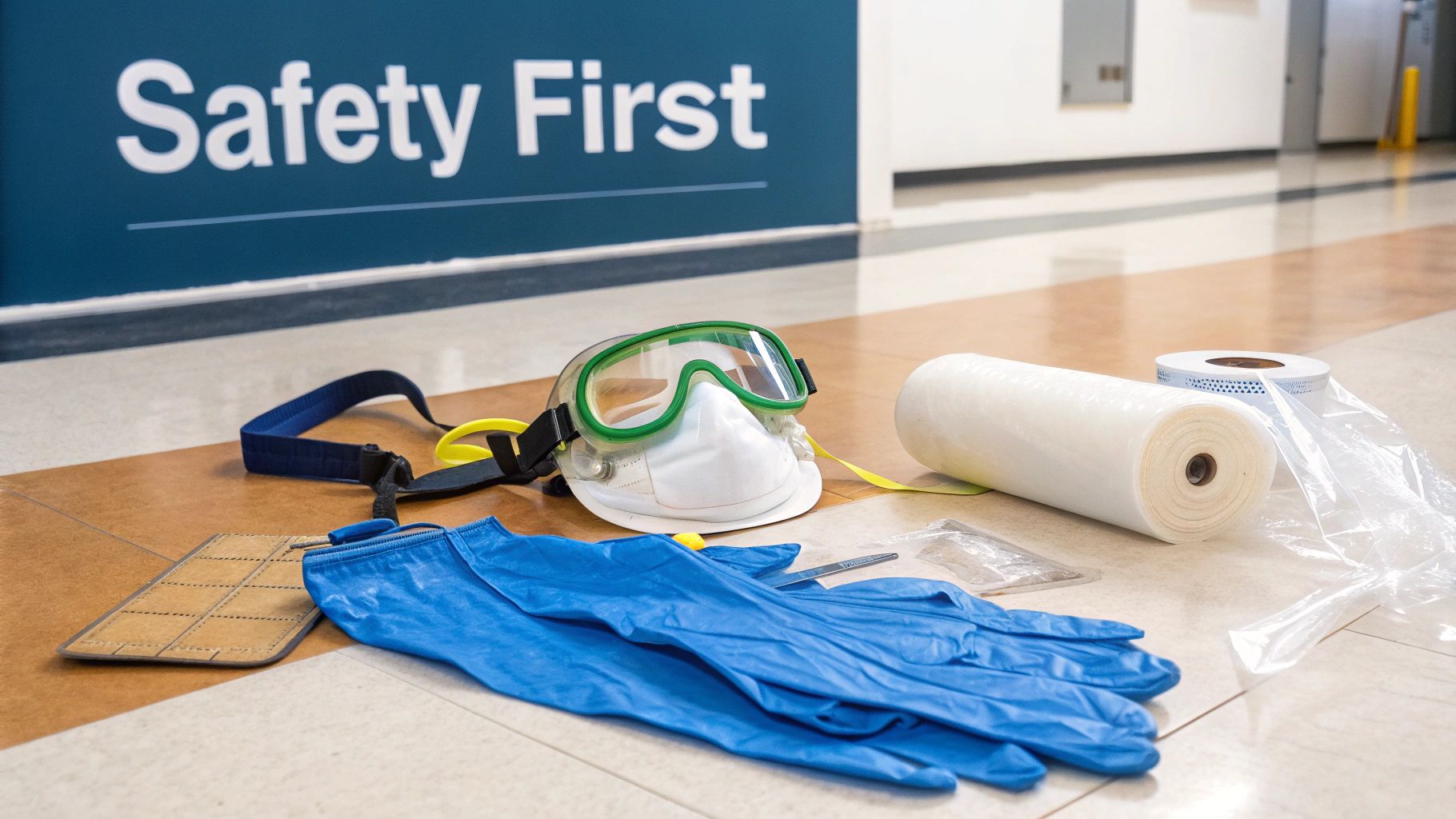
Before you even think about scrubbing, your absolute first priority is safety and containment. When you disturb a patch of mold, you can easily send a cloud of invisible spores into the air. This not only spreads the problem to other parts of your home but can also be seriously harmful to your respiratory health. Think of this not as simple cleaning, but as a careful, strategic operation to protect your home and health.
The right Personal Protective Equipment (PPE) is completely non-negotiable. Even for a small job, you need a baseline of protection to avoid breathing in spores or getting them on your skin. Professional services, like those offered by Simon Air Quality, never skip this critical step.
Your Essential PPE Checklist
- N-95 Respirator: This is your most critical piece of gear. It’s designed to filter out the microscopic mold spores you don’t want in your lungs. A standard dust mask just won’t cut it.
- Safety Goggles: Spores can irritate your eyes, too. Grab a pair of non-vented goggles to keep them protected from airborne particles and any cleaning solution splashes.
- Non-Porous Gloves: Simple rubber or neoprene gloves are perfect. They create a solid barrier between your skin and the mold itself, as well as any chemicals you use.
Once you’re geared up, the next job is to isolate the room. Use plastic sheeting and tape to seal off any doorways that lead to the rest of the house. A great pro tip is to place a fan in an open window, pointing it outwards. This helps create negative air pressure, pulling spores out of the house instead of letting them drift into other rooms.
At Simon Air Quality, our professional mold removal services are built on these exact principles, just on a much larger scale. We set up professional-grade containment barriers and use powerful air scrubbers to guarantee the rest of your home stays completely safe and protected during the entire remediation process.
It's also good to remember that not all molds are the same. Common varieties, like the ones you might see as white fuzz, can carry different risks. We've put together a guide on whether white mold is harmful that goes into more detail. For any job that produces contaminated waste, it’s always smart to review the proper steps to safely manage hazardous waste to ensure you're disposing of everything correctly.
A Practical Guide to DIY Carpet Mold Removal
So, you’ve found a small patch of mold on your carpet. Before you panic, know that if you've caught it early and it's just on the surface, a DIY approach can often do the trick. We're talking about minor spots, usually smaller than the palm of your hand, where the mold hasn't had a chance to sink into the carpet padding. Tackling it now can save you from a much bigger headache later on.
Before you start scrubbing, it's absolutely crucial to test your cleaning solution on a hidden spot. Think inside a closet or under the sofa. This quick check makes sure you won't accidentally discolour or damage your carpet fibres. When it comes to mold, safety first is always the best policy.
Using Natural Solutions Effectively
You don't need harsh chemicals for a small job. A simple mix of equal parts white vinegar and warm water in a spray bottle works wonders. Vinegar is a mild acid, but it's surprisingly effective at killing off many common surface mold spores without damaging your carpet.
Lightly mist the affected area—you want it damp, not soaking wet. Let the solution sit and work its magic for about an hour. This gives the vinegar time to penetrate the mold and break it down.
Next, grab a stiff-bristle brush and gently scrub the spot. A good tip is to work from the outside of the patch inward; this helps prevent spreading the spores to clean areas. After scrubbing, blot the area with clean, dry cloths until you’ve soaked up as much of the liquid as possible.
Critical Warning: Whatever you do, never use bleach on your carpet to treat mold. Bleach is notorious for damaging and discolouring carpet fibres, and the fumes can be hazardous in an enclosed room. On top of that, it often fails to kill the mold's "roots" deep within porous materials like carpet, meaning the problem will likely just come right back.
The last step is easily the most important: thorough drying. Get a fan pointing directly at the damp spot or place a dehumidifier in the room and let it run for at least 24 hours. Any leftover moisture is basically an open invitation for the mold to return. This drying principle is just as important in other damp-prone areas, a topic we cover in our guide on how to remove mold from a basement.
As you clean, mold spores will inevitably get kicked up into the air. To give your home’s air quality an extra layer of defence, consider running an air purifier. A quality unit like the Amaircare 3000 is designed to capture these microscopic particles, helping to protect your family from breathing them in.
Comparing DIY Mold Removal Methods
When you're dealing with a small mold spot on your carpet, several household items can be used. It's helpful to know the pros and cons of each before you start.
| Method | Effectiveness on Surface Mold | Carpet Safety | Best For |
|---|---|---|---|
| Vinegar & Water | High. Kills most common mold species. | Good. Generally safe, but test first. | Natural cleaning on most carpet types. |
| Baking Soda & Water | Moderate. Good for scrubbing and odour removal. | Excellent. Very gentle on fibres. | Removing musty smells and light surface mildew. |
| Hydrogen Peroxide (3%) | High. A strong antifungal agent. | Caution. Can have a mild bleaching effect. | Light-coloured or white carpets only. |
| Tea Tree Oil & Water | High. A natural and potent fungicide. | Good. Dilute properly and test first. | An effective, natural alternative to vinegar. |
Each method has its place, but always remember that for small, surface-level issues, a gentle and thorough approach is key. Proper drying is non-negotiable, no matter which cleaner you choose.
When You Need Professional Mold Remediation
While it's tempting to tackle a small mold spot yourself, knowing your limits is absolutely crucial. Some situations are just too big or too hazardous for a DIY approach. Recognizing these red flags is the key to protecting your property and, more importantly, your family's health.
The clearest sign you're out of your league is the size of the affected area. If you're looking at a patch of mold larger than 10 square feet—that’s roughly a 3-foot by 3-foot square—the problem is far too widespread for household solutions. An infestation that big is releasing a huge volume of spores and almost certainly means the issue has penetrated the carpet padding and subfloor.
Another major red flag? The mold keeps coming back. If you’ve scrubbed an area clean only to see that familiar fuzzy growth return, it’s a sure sign your efforts didn't get to the root of the problem. This usually happens when moisture is trapped deep within the carpet padding, where surface cleaners can't possibly reach.
This quick visual can help you decide whether to grab your cleaning gear or pick up the phone.
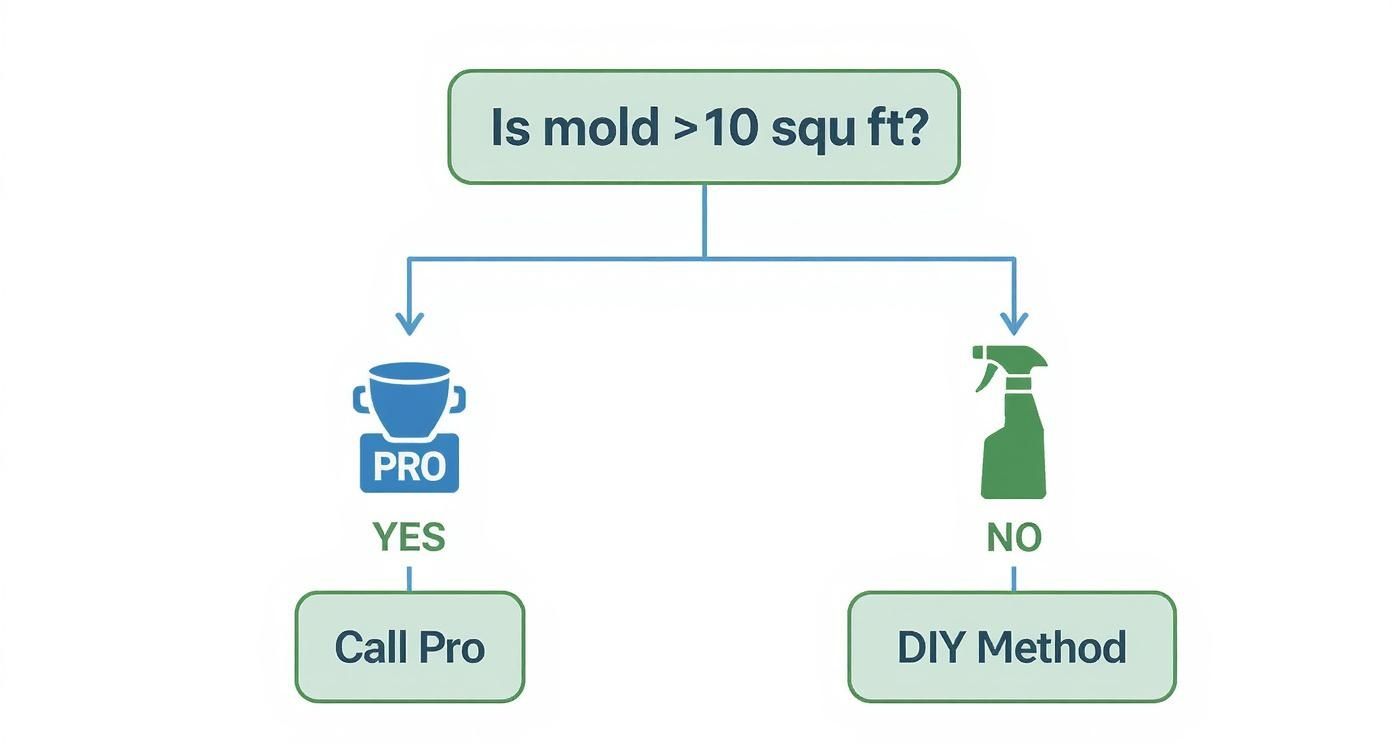
As you can see, the scale of the mold is the number one factor in determining your next move.
When the Source Is a Major Issue
The cause of the mold is just as important as the size. If the growth started after a major water event—think a burst pipe, serious flooding, or exposure to contaminated water like a sewage backup—professional help isn't just recommended, it's non-negotiable.
This kind of severe water damage completely saturates the carpet, padding, and subfloor, creating a perfect breeding ground that only commercial-grade extraction and drying equipment can handle.
Once mold has reached the carpet padding or subfloor, it’s impossible to remove with surface treatments alone. This is where Simon Air Quality's certified mold removal services are essential. We address the complete health of your home environment, from the source to the air you breathe.
Our team uses advanced moisture detection tools to hunt down every last bit of hidden dampness. We then set up proven containment protocols and bring in powerful equipment to safely eliminate the problem at its source. We finish with air quality testing to verify your home is clean and safe again.
This comprehensive approach is vital. For more details on what professional work entails, you can find great insights on the costs and procedures for professional remediation on Houseloc.com.
Long-Term Strategies to Prevent Carpet Mold
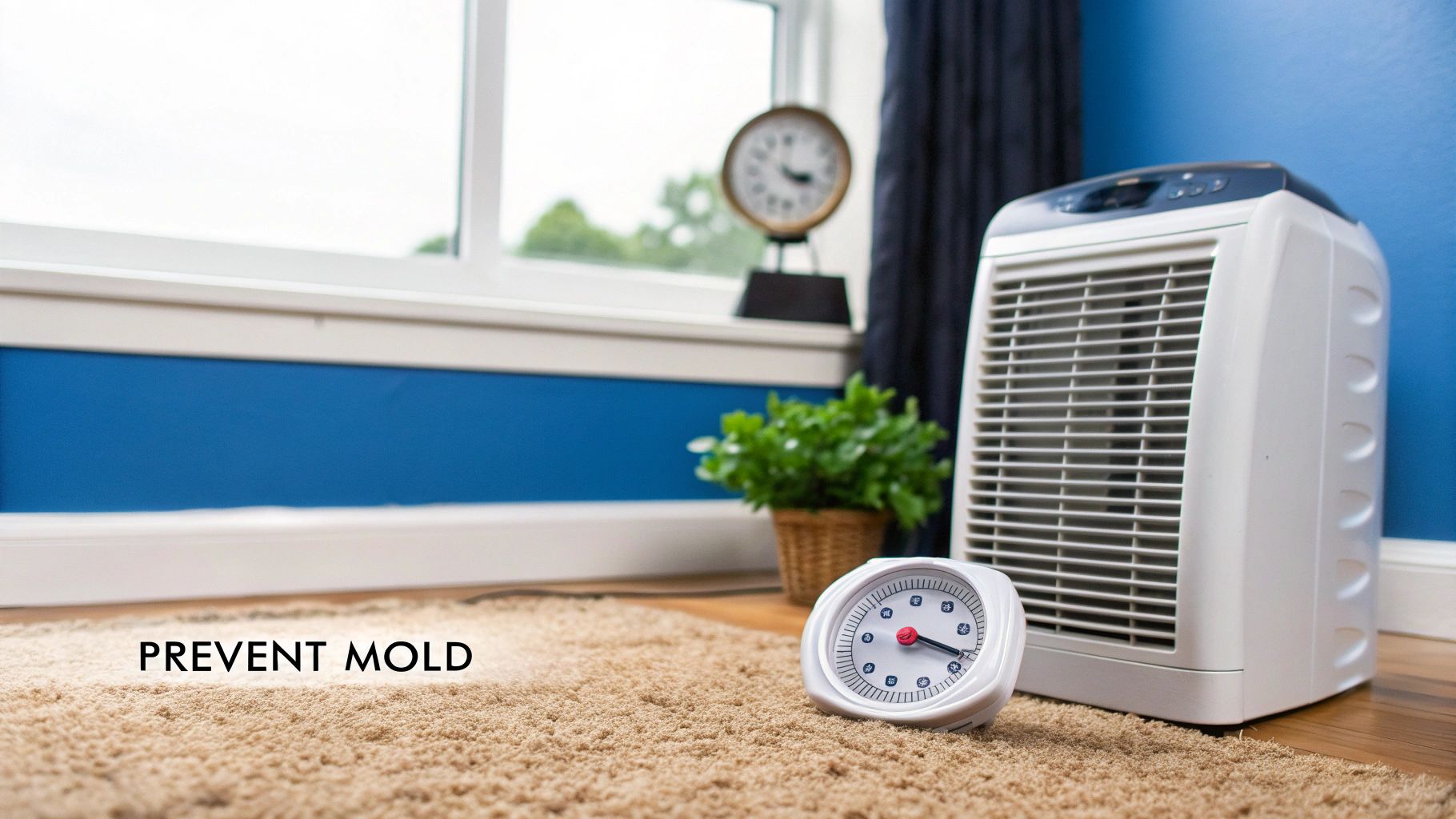
Getting rid of mold is a big win, but the real victory is making sure it never has a chance to come back. To do that, you need to shift to a proactive mindset, and it all boils down to one thing: moisture control. Without water, mold simply can't get a foothold.
This means becoming a bit of a detective for any potential water sources in your home. Get on top of even the smallest leaks from pipes or appliances right away—a slow, ignored drip can easily saturate your carpet and underpadding over time. Spills are another big one. When they happen, the clock starts ticking. Clean them up as soon as you can, with the goal of getting the area bone dry within 24 to 48 hours.
Proactive Moisture and Air Management
Beyond direct leaks and spills, you have to manage the moisture in the air itself. Controlling the ambient humidity, especially in those damp-prone spots like basements or laundry rooms, is a game-changer. Running a dehumidifier in these areas can make all the difference, aiming to keep your indoor humidity below 50%.
Don't forget about proper ventilation. High-humidity zones like your kitchen and bathrooms need good airflow, especially while you're cooking or showering and for a little while after. Using exhaust fans is a simple but highly effective preventative measure.
At Simon Air Quality, our philosophy centres on creating a holistically healthy home. This involves not only addressing existing issues like mold or high radon levels but also implementing systems that continuously protect your indoor environment. Our comprehensive approach ensures your home isn't just clean, but truly safe.
A huge part of this is maintaining healthy indoor air quality. An investment in a high-efficiency air purifier can continuously pull airborne mold spores out of the air before they find a place to land and grow. A unit like the Amaircare 3000, for example, is built specifically to filter out these microscopic particles. Think of it as a powerful, ongoing defence system against future mold problems.
Your Questions About Carpet Mold Answered
Even after walking through the cleanup process, it’s completely normal to have a few more questions. When you find mold in your carpet, a lot of concerns can pop up. Let's tackle some of the most common ones we hear from homeowners.
Can You Get Sick from a Moldy Carpet?
Absolutely. Exposure to a moldy carpet can definitely affect your health. Mold pumps microscopic spores into the air, and for many people, that means allergic reactions are just around the corner—sneezing, coughing, itchy eyes, you name it. If anyone in your home has asthma or other respiratory issues, these spores can make their symptoms much worse.
This is a big reason why cleaning up your indoor air is just as important as cleaning the carpet itself. A serious air purifier, like the Amaircare 3000, is built with a HEPA filter specifically to trap these tiny airborne invaders. It's a critical step in making sure the air your family breathes is healthy again.
When Is a Carpet Beyond Saving?
This is the million-dollar question: do you clean it or toss it? From our experience, there are a few clear signs that a carpet is a lost cause.
- The Spread is Too Big: If the mold covers an area larger than 10 square feet, you're past the point of a DIY fix. That's a sign of a much bigger problem that surface cleaning just won't solve.
- It's Soaked Through to the Padding: Once mold gets into the carpet padding or the subfloor underneath, it's game over. The padding is like a giant sponge; it holds onto moisture and lets mold flourish where you can't even see it. Trying to clean it is futile.
- The Water Was Contaminated: If the source of the moisture was something like a sewer backup or overland flooding, that carpet has to go. The health risks from the bacteria and contaminants in the water are severe.
When you're facing any of these situations, the only truly safe option is to have the carpet professionally removed and disposed of. If you try to save it, you're likely just setting yourself up for more mold down the road and ongoing health risks.
At Simon Air Quality, our mold removal services always start with a proper assessment. We’ll tell you straight up if your carpet can be saved or if replacement is the only way to get your home genuinely mold-free. We can also help with radon services, tackling another hidden danger that could be compromising your home's air.
For a complete assessment of your home's air quality and expert solutions for mold, radon, and more, trust the professionals. Simon Air Quality provides certified remediation and air purification systems to protect your family's health. Learn more at https://www.simonairquality.com.


